Justice for Genesis: A Scientific Exploration
John C. Walton. 2025. Andrews University Press. ISBN-13: 978-1940980317.

John C. Walton. 2025. Andrews University Press. ISBN-13: 978-1940980317.
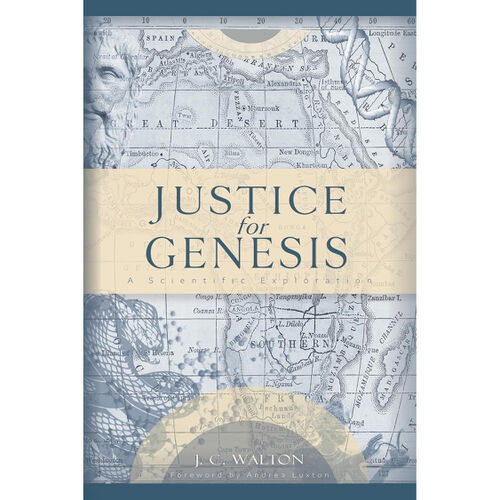
John C. Walton is emeritus professor of chemistry at St Andrews University in Scotland, UK. He has published over 300 scientific articles and has written three books. He should not be confused with John H. Walton, a theologian at Wheaton College. In Justice for Genesis, Walton combines several lines of evidence to conclude that the book of Genesis is historically accurate and reliable. The book should be read by anyone interested in development of a theory of creation that is faithful to both the Bible and the study of the physical world.
The book is divided into sixteen chapters arranged in five sections. The first section, with four chapters, deals with the materialistic bias that pervades academia and the public media. Walton gives several reasons for examining Genesis from an open perspective, free of materialistic presuppositions. Recent advances in learning have shown the Darwinian project is flawed. Archeological discoveries have confirmed many of the details in Genesis. Many reports of miraculous events are well-attested, casting doubt on materialist claims that miracles are not possible. The existence of a moral sense in humans is not explained by naturalistic processes. The fitness of the environment for life, and the specified complexity of living cells have no better explanation than intelligent design.
Walton gives two rational arguments for the existence of God. The kalam argument states that anything that comes into existence must have a cause. Since the universe had a beginning, it must have a cause. That cause must be independent of the universe, since it existed before there was a universe. That cause is God. The second one is the argument from thermodynamics. In a closed system, order tends to break down. If the universe is a closed system and infinite in age, it could not retain order. Since the universe is obviously ordered, it cannot be both infinite in age and a closed system. In either case, an outside agent (God) is required. The force of these arguments can be seen from the strained efforts made to refute them. Several other classical arguments for the existence of God rely on nonbiblical premises about God’s nature, and are not consistent with the God of Christianity. Walton examines arguments against the existence of God and shows that each one fails.
The second part of the book consists of a single chapter on the literary composition of Genesis. This chapter summarizes the evidence for the Mosaic authorship of Genesis, written near the time of the Exodus from Egypt by an author familiar with both the Egyptian court and the geography of the surrounding region. Alphabetic writing has been shown to exist since some time prior to the Exodus. The accurate preservation of the text is affirmed by discovery of scrolls, inscriptions, and amulets from hundreds of years before Christ, with some even before the Babylonian captivity. Textual references to ancient places and persons are not reasonably attributed to later dates, when knowledge of these persons and place names had been lost. The narrative text has literary structures indicating consistent single authorship, with features that enhance oral presentation. The care taken in counting the time, the numbers of people, and measurements of structures indicate a writer who was concerned about accuracy of detail. All these characteristics of the text point to the conclusion that it was written in the second half of the second millennium BC, by a person whose training and expertise points to Moses.
The third section contains four chapters dealing with the age of the earth. This may be the most interesting, and most controversial, portion of the book. Chapter six, on geology and the flood, depends heavily on the discussion of six North American megasequences by Timothy Clarey.[1] If the North American megasequences are truly global, they would be helpful in understanding the processes active during the flood. However, there are many gaps in the sedimentary record, which makes the situation rather complicated. Much work remains to be done in this area, but it is encouraging that enough data have been collected to allow for development of some qualitative modeling.
Walton expresses doubts about conventional radioisotope dating systems because they are based on minerals that are held together by ionic bonds and hence are subject to leaching by groundwater. Radiocarbon dating is based on molecules with covalent bonds, and are much less subject to leaching. Thus, we can have more confidence in radiocarbon dating. Walton provides a more detailed exposition of his views on radiocarbon dating in his book, Compact Time.[2]
Radiocarbon dating requires knowledge of the concentration of carbon in the atmosphere at the time of preservation. We know the present amount of atmospheric carbon, and we can check on past concentrations by comparing radiocarbon dates with historical dates. There is good agreement between the two systems for the past 3,000 years, but older radiocarbon dates show increasing deviation from historical records. This is likely due to the effects of the flood. Walton applies Robert Brown’s method of calibrating conventional dates[3] to show how radiocarbon dates can be converted to dates consistent with a short chronology for life.
Biological materials decompose over time, due to activities of microorganisms, and chemical reactions with water or oxygen. Soil components may have catalytic properties that accelerate the rate of decay. Decay processes are rapid compared to the geologic time scale. Eventually, soft tissues will leave nothing but carbon dioxide, or a layer of charred carbon, or an impression in the sediment. Discovery of soft tissue in the fossil record is convincing evidence against the possibility they could be millions of years old.[4]
The next three chapters deal with archaeology and Genesis. Several creation myths are known from the Ancient Near East (ANE). These have both similarities and differences with the Genesis creation account. Similarities include a global disaster in which a favored person or group was able to survive in a boat thanks to warning from one of the gods. In addition, three elements of the Genesis story are commonly found in ANE artifacts: a tree, a serpent, and an angel. Despite the similarities, the Genesis story is radically different from the ANE stories. Genesis describes a benevolent God who creates effortlessly and without violence. He shows the value of humans by giving them His own image and appointing them to care for the rest of the creation. Genesis appears to have been written to correct the false ideas in the other ANE stories.
There is strong evidence for the historicity of the global flood recorded in Genesis. Cultural traditions of an ancient global flood have been recorded from all the inhabited continents. Pre-historic monuments and other structures from many parts of the world suggest a sophistication of engineering knowledge among the early post-flood people groups. The table of nations in Genesis 5 lists many names that can be identified with individual from ancient historical records.
Genesis contains other information that can be confirmed by modern discoveries. Contrary to claims by some evolutionists, it is plausible that the extensive genetic diversity among modern human could have arisen from a single ancestral pair within the time frame indicated in the Bible. The Genesis story also explains the origin and diversification of human languages. Descriptions of cultural practices in patriarchal times have been corroborated by archaeological finds, including the existence of cities, details of cultural practice such as covenant ratification and surrogate motherhood, and the use of camels.
The final section consists of four chapters that discuss a variety of topics. The creation account reveals a God who created everything by the power of His word. Since God is not a part of the universe, but preceded the creation of time and space, He is eternal. Since God created the entire universe and everything within it, He is omnipotent. It is appropriate that humans show Him reverence and admiration. We do not know what God is made of, although we know He can appear in the form of an angel or human. We do not have an exact date for the creation, and it is not clear whether life on our earth was created at the same time as the universe was created, but we can know that earth was populated some thousands of years ago, and not millions of years ago. We also know why God created, because He has told us. He created us because He wanted to express Himself in loving relationship, which is His glory.
This section also includes a chapter on the origin of life. Genesis describes how God prepared the planet for life by providing light, atmosphere, dry land, and seasons marked by the sun and moon. Plants were the first living organisms created on earth. Their cellular structure and metabolism point to a designer of unparalleled wisdom and technical skill. Walton introduces the reader to the concept of “Chemical Space,” which is the sum of the total possible ways atoms can combine to form different types of molecules. This “space” is vast beyond comprehension. Considering only proteins of about 250 units of amino acids, the number of possible combinations is greater than 10325. Since the number of electrons in the known universe is estimated to be about 1080, one can see the impossibility of finding a useful protein by chance. Even if one had a biomolecule, it would be destroyed quickly by reaction with chemicals in the environment unless it was protected by a membrane. A living cell could never be produced stepwise, but all components must be produced, properly arranged, and protected by a membrane at the same time.
Evidence of creation by an intelligent designer is abundant in living organisms. Cells are made of complex systems of molecular machines, none of which could long survive outside the cell. DNA contains information for regulating the life of the organism. Information is a hallmark of intelligence, and the quality of information in DNA is unknown apart from living organisms. Cooperation, mutual benefit, and altruism are found throughout nature, and are best explained by creation by a good creator. The fitness of the environment for life is not an accident, but a carefully designed system by a skillful creator. All these points combine to point to a Creator who is intelligent and good.
If God is good, then why is there so much evil in the world? Genesis provides a hint about the source of evil, and this is further described in other parts of the Bible. Hints of a cosmic conflict appear early in Scripture, in Genesis 3. An evil being either appeared as a serpent or manipulated a serpent, to tempt Eve to eat fruit from the tree of knowing good and evil. The evil force behind this was a fallen angel, once called Morning Star according to the biblical text, but now known as the enemy, the devil, and Satan.
God permits evil to persist only because it is the only way to demonstrate the end result of Satan’s rebellion, and God values our freedom of choice more than His own comfort and convenience. The focal point was when God became one of us, and was abused and finally crucified by those He had created, pushed onward to that end by Satan himself. Once it has become clear that God’s method of rule is the best of all possibilities, and everyone has freely chosen whether to join with Satan or follow God’s counsel, He will intervene to separate evil from the world. Then He will create a new world in which love is the guiding principal, and there will be no more death, suffering, or rebellion.
The message of Genesis is good news. As the Creator of everything, God is intensely interested in the state of the creation. He designed the world to support life, and tasked humans with keeping it in good condition. He deeply loves the creation, especially the sentient creatures He made in His own image and gave authority over the other living things. Our lives have meaning because they are intended and valued by the Creator. The story of the Bible is the story of creation, fall, redemption, and new creation. Genesis describes the original creation as a garden, called Eden or paradise. The Bible ends with a description of the new creation, complete with elements of the original creation such as the tree of life and the river that flows through the garden, and no death. In the end, love is triumphant.
Reviewed by Jim Gibson, PhD
[1] See https://www.grisda.org/carved-in-stone
[2] Reviewed at https://www.grisda.org/compact-time
[3] https://www.grisda.org/origins-17056
[4] E.g., see https://www.grisda.org/preservation-of-dinosaur-soft-tissue-an-update-1