





©Copyright 2018 GEOSCIENCE RESEARCH INSTITUTE
11060 Campus Street • Loma Linda, California 92350 • 909-558-4548

All Galleries
All Images




Flat pebbles
This picture shows three beds containing numerous intraclastic flat pebbles from upper Cambrian strata of the Notch Peak Formation, Utah. We find analogous flat-pebble conglomerates in lower Paleozoic strata from many different regions of the world, including China, North America, Australia, and Korea. In this and other similar cases, Paleozoic rocks record a global signal. Scale in cm.
Nonconformity
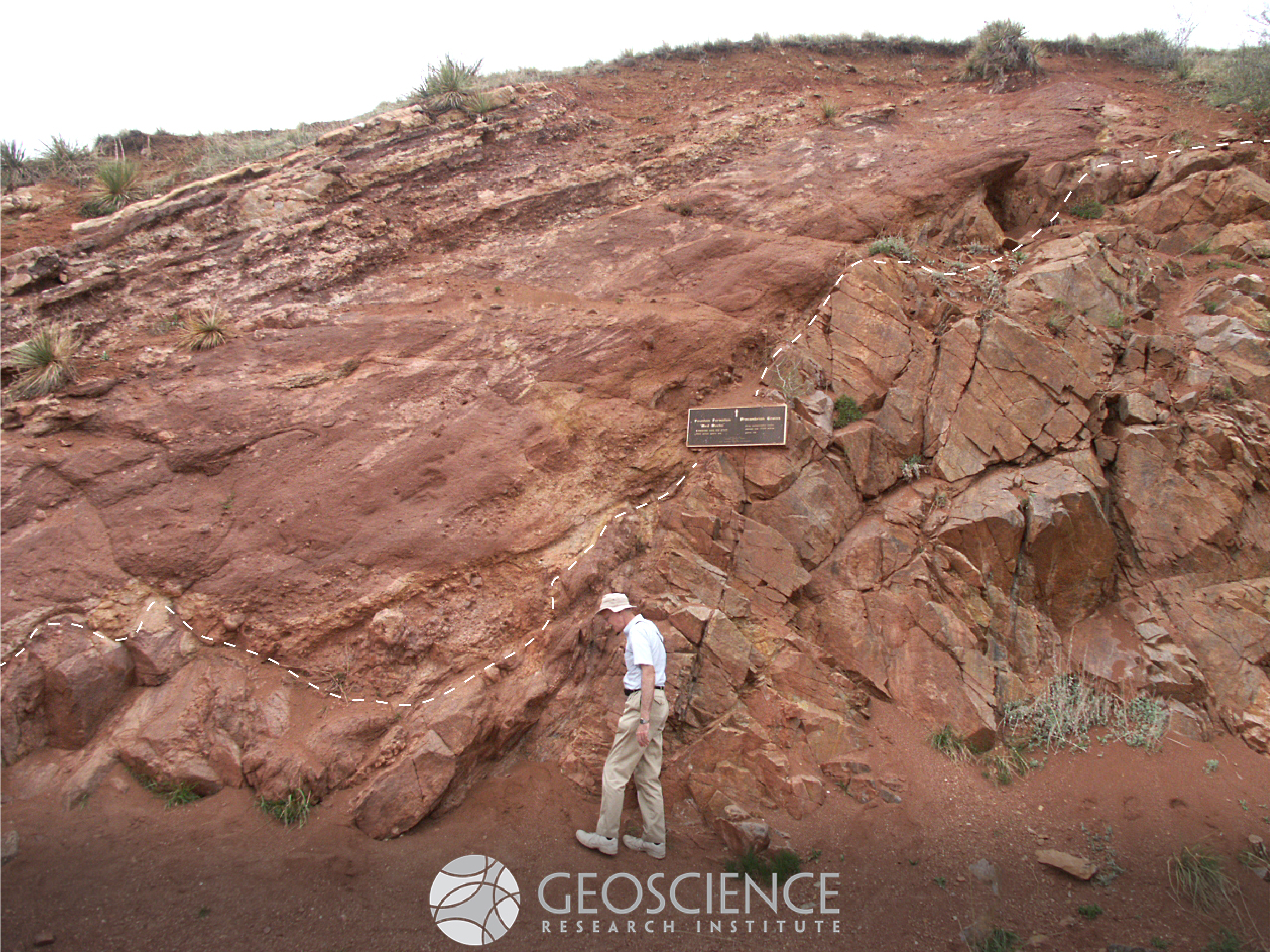
A "nonconformity" is a type of discontinuity surface where sedimentary rocks lie above crystalline rocks. The dashed line in the picture marks a nonconformity between the Mesoproterozoic Pikes Peak Granite (bottom/right) and the Pennsylvanian conglomerates of the Fountain Formation (top/left), near Denver, CO. The contact in this outcrop (near Red Rocks Amphitheater) is marked by a plaque.
Principle of inclusion
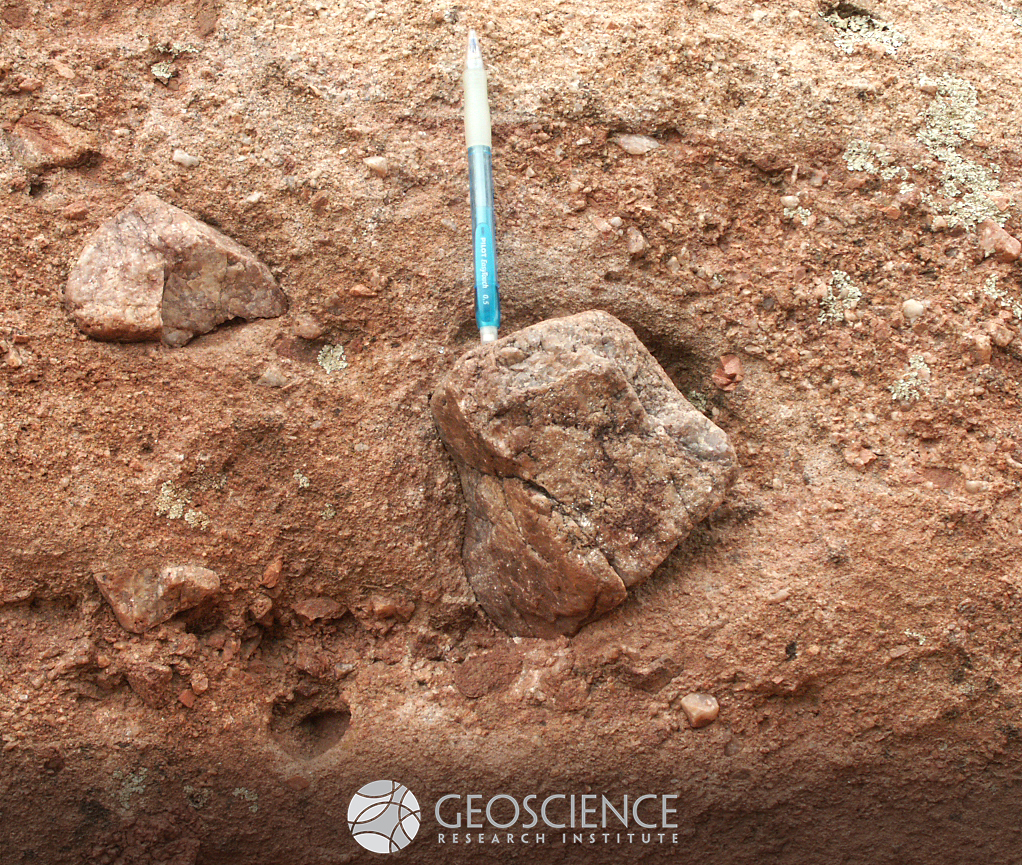
One of the basic principles of stratigraphy is the "principle of inclusion." The principle states that if fragments of a rock unit are found included in a second rock unit, the second unit is younger than the first. In this picture, fragments of the Mesoproterozoic Pikes Peak granite (like the clast on which the pencil is resting) are included in a conglomerate layer of the Pennsylvanian Fountain Formation, CO. We infer that the granite must have existed as a solid rock body that was broken and eroded…
Unconformity
The angular contact running diagonally across the photos (hammer for scale in the center of the image) is an unconformity between basaltic volcanics on the left (Fernazza Formation) and volcaniclastic sedimentary deposits on the right (Wengen Formation). Both units are Triassic in age. This outcrop records three dynamic, high-energy, geological processes: 1) Igneous: eruption and emplacement of basaltic volcanics, underlying the contact; 2) Tectonic: tilting and deformation producing the angular…