



©Copyright 2018 GEOSCIENCE RESEARCH INSTITUTE
11060 Campus Street • Loma Linda, California 92350 • 909-558-4548

Download PDF
This article was originally published as a chapter in the book “Design and Catastrophe: 51 Scientists Explore Evidence in Nature"
We often hear of millions of years being necessary for the formation of the geologic layers of the earth. The long ages proposed are based on a detailed geologic timescale that is accepted as being reliable by much of the scientific community. Most of these layers are sedimentary and are assumed to have accumulated slowly as the result of relatively local activity. This view is in stark contrast to the biblical account of a recent creation and a catastrophic worldwide Flood that would rapidly lay down a major part of the sedimentary record in just one year. Which view is true?
When one examines the sequence of sedimentary layers, one finds major widespread gaps between some of them. In other words, part of the expected geologic layers that are found elsewhere over the earth are missing. Furthermore, the contact surfaces where gaps are located are notoriously flat; layers above the gap lie flat over flat layers below the gap. Geologists use the term “paraconformity” to designate these “flat gaps.” They associate the gap in the rock layers to a time gap, representing the time assumed for the formation of the missing layers. However, the fact that these gaps are so flat challenges the proposed long geological ages.
Figure 47-1 gives three examples of paraconformities seen in the sedimentary layers of the famous Grand Canyon of the Colorado River. The three arrows point to lines representing gaps of 6, 14, and 100 million years of missing layers, according to the standard geologic timescale. Both the Ordovician and Silurian geologic periods are missing at the 100-million-year gap. The gaps are usually assumed to be there because these regions were, for some time, elevated areas. There, sediments would not accumulate, but would instead be weathered, eroded, and transported by streams and rivers to accumulate in lower regions.
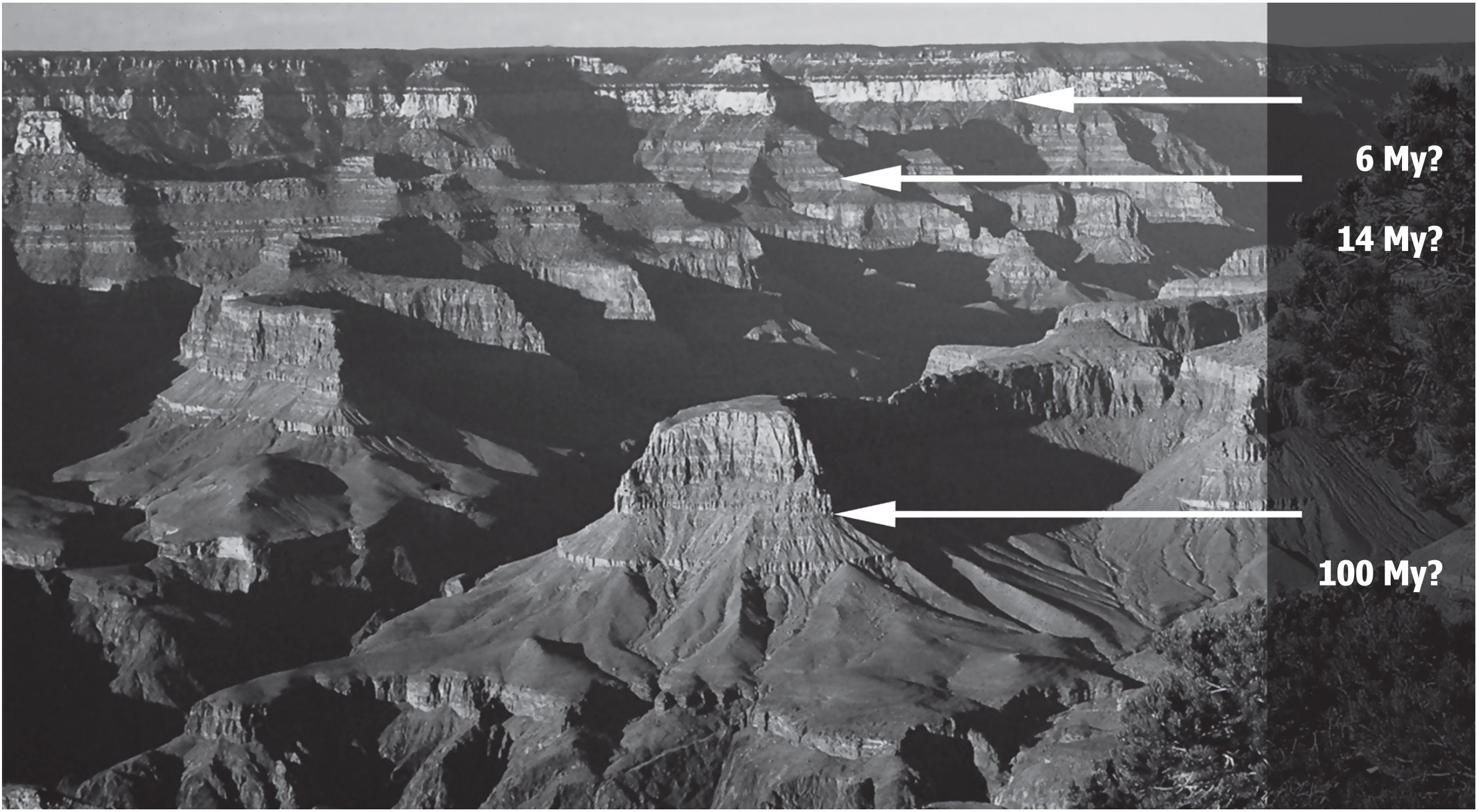
However, the expected erosional activity of streams and rivers over the proposed millions of years is not there. Erosion tends to leave an irregular topography as streams and rivers cut deeper and deeper. How much erosion would be expected over the proposed millions of years? An average of 12 studies estimating the present downward rate of erosion of the world continents indicates it is around 60 m per million years.[1] That may seem slow, but it is a rate that would erode our present continents to sea level at least a hundred times over their proposed geologic age.
At that same rate, you would expect ~360 m, ~840 m, and ~6 km of erosion at the three gaps identified in Figure 47-1 for the Grand Canyon. In perspective, the Grand Canyon is only ~1.6 km deep. However, the gaps are still flat, as though little time had occurred between the layer below and above the gap, as is expected for the rapid activity of the great Genesis Flood. Some layers, like the layer at the top edge of the Grand Canyon, are harder than others and would erode more slowly than average, while others, like the layers under the 6- and 14-million-year gaps, are soft and would erode faster than average. Locally, there is evidence of small channel erosion at some gaps, as is the case for the lowest arrow in Figure 47-1, but maximum depth of erosion there is only about 0.5% of the overall average erosion expected over the long geologic ages proposed for that gap.[2]
The flat gaps can be huge, covering hundreds of thousands of square kilometers, and are found in many regions of the world.[3] According to standard geologic interpretations, these would represent vast flat areas, but why were they not sculpted and eroded over the alleged many millions of years? If there is a gap, plenty of evidence for prolonged exposure and erosion would be expected. The lack of this evidence in flat paraconformities challenges the assumption that the long geologic ages ever occurred.
NOTES
[1] AA Roth. Origins: linking science and Scriptures. Hagerstown (MD): Review and Herald Publishing Association; 1998, pp. 263–266.
[2] For a discussion of eight questions about these gaps, see AA Roth. “Flat gaps” in sedimentary rock layers challenge long geologic ages. Journal of Creation 2009; 23(2):76–81.
[3] For more examples, see Discussion 16 on the author’s website: www. sciencesandscriptures.com.
Ariel A. Roth is retired director of the Geoscience Research Institute. He holds a PhD in Biology from the University of Michigan. He has served as faculty at Andrews University and Loma Linda University and has been studying the controversy between science and the Bible for some 70 years. His publications include some 200 articles in the scientific and popular press, and two books available in 17 and 24 languages. His webpage is www.sciencesandscriptures.com.