Exploring the Universe through the Dual Lens of Scripture and Science
Sven Östring and Elisapesi Manson (Editors). 2026. Avondale Academic Press. ISBN-13: 978-0645914177

Sven Östring and Elisapesi Manson (Editors). 2026. Avondale Academic Press. ISBN-13: 978-0645914177
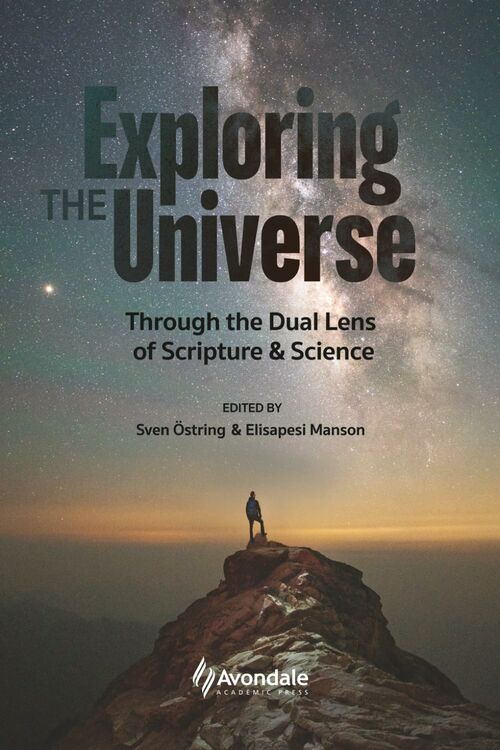
This is a collection of 15 essays that explore a Christian view of cosmology and its implications. The chapters are organized into five topics: Foundational Concepts; Cosmology; Astrobiology; Eschatology; and Practical Contributions. The authors include scholars in both science and mathematics and in biblical studies. Readers with some background in the sciences will find the book an interesting and valuable read. The book is highly recommended.
The first section, on foundational concepts, consists of three chapters. In the first chapter, mathematician Anthony Bosman considers the uniquely human ability to use mathematics to solve problems. This is explained by the Christian view of mankind created in God’s image. The discovery that the laws of nature have a mathematical basis is surprising to many, and points to an intelligent creator. In chapter two, Stephan Simmons explores the relationship of divine miracles to natural laws. Natural laws apply only to closed systems, and the universe is not a closed system with respect to God. Therefore, divine miracles do not violate the laws of nature. Anthony Bosman contributed the third chapter, in which he discusses whether God experiences time (God is temporal), or whether all past, present, and future events are simultaneous in God’s mind (God is timeless). The Bible is clear that God lives from everlasting past to everlasting present, and He is the alpha and the omega – the beginning and the end. These expressions clearly indicate that God is temporal – He experiences different events in a sequence based on time, not all at one time, even though He can see the future.
The second section includes four chapters dealing with cosmology. Emanuel Millen addresses issues of time and scope in the Genesis 1 account of the events of creation days 1, 2 and 4. While adopting a literal-historical interpretation of the text, Millen points out that there are some ambiguities in the account, but these do not affect our understanding of God, humanity, or salvation. The meaning of the “days” of creation has been discussed extensively, but most scholars recognize that the author intended the days to be literal days similar in length to those we experience today. Ambiguities also exist in science, as pointed out by Sven Ostring in his chapter on under-determination of theory in science. An explanatory theory may be preferred because of its simplicity or exclusion of supernatural, rather than because it is the only available explanation. Exclusion of reference to the supernatural restricts science to naturalistic theories. Science has been successful in explaining how things usually work. However, the very existence of the universe seems to call for a supernatural Creator. Hence scientific claims that rely on the absence of divine action may conflict with Scripture, and should be regarded with caution.
Big Bang Theory (BBT) is the topic of chapters 6 and 7. Aleksei Popov finds several points of agreement, and some disagreement, between the Big Bang Theory and the Biblical account of creation. Both agree that the universe came into existence in a unique event, or singularity, which has no scientific explanation. They agree the universe came into existence in a highly specified, finely tuned state, and has lost some of its original order. Two major points of disagreement are the future of the universe and the role of a divine Creator. Mickey Kutzner reviews the major discoveries in development of the BBT. Several lines of evidence support the theory, and it the best available theory. Some scientific problems for the theory remain, and the theory is far from proved, but it is a useful tool for scientists. It is important to note that the Bible is clear that the universe is not closed to divine activity as claimed by naturalistic scholars, but is dependent on divine activity, both in creating and in sustaining the universe.
The third section of the book is concerned with astrobiology: Is there life outside the earth? In chapter 8, Emanuel Millen discusses the meaning of “the sons of God” in Genesis 6 and Job 1, 2, and 38. In Job 38, the “sons of God” existed before the earth was created, suggesting they were non-human life forms, perhaps angels and/or beings from other created worlds. Mickey Kutzner explores the implications of exoplanets in chapter 9. Hundreds of exoplanets have been discovered, and it is appears they are more numerous than the stars. It is not known whether any exoplanets might be home to some of the “sons of God” mentioned in Job, but the idea is an intriguing one, and is not ruled out by Scripture. In chapter 10, Timothy Standish discusses the idea of Panspermia - life came to Earth from outer space. The hypothesis of panspermia requires that life be present somewhere else in the universe. No such life is known to science. Some have proposed a Directed Panspermia, in which intelligent beings transport life to our planet. This hypothesis pushes the problems for panspermia back in time and space where evidence is impossible to obtain, leaving a free reign for speculation. The best and only plausible explanation for life is our Creator, Jesus Christ.
The fourth section of the book deals with the topic of eschatology. What is the future of the universe? Christopher Petersen addresses the question from a biblical perspective in chapter 11. Petersen identifies several good reasons to have confidence in the promise of a new creation. In chapter 12, Josue Cardoso dos Santos compares speculations regarding the end of the universe from such diverse sources as Greek philosophy, Hindu teachings, secular scientific thought, and contrasts these with the biblical perspective. Secular modern science sees three possibilities for the end of the universe: an eternal expansion resulting in the Big Freeze, a collapse onto itself resulting in the Big Crunch, or disintegration in the Big Rip. Biblically, God will sustain the universe and His people through eternity.
The final three chapters are grouped under the topic of practical contributions. In chapter 13, Ben Clausen discusses his experiences as a research scientist studying topics that have not produced results that would be expected from a biblical perspective. Clausen emphasizes the need to be accurate and honest with the data, while maintaining confidence in Scripture. He gives several examples of interactions he has had with other scientists of various persuasions, and how he has been able to make friends with them without compromising his own faith or alienating them.
Noemi Duran describes the Seven Great Stories Project in chapter 14. The Seven Stories include such topics as creation, human nature, the Fall, natural history, and restoration. Each of the seven stories is followed by science topics that relate to that story. Each school year the stories are retold and the science topics explored in greater depth. This “spiral” teaching approach reinforces previous learning while at the same time increasing the scope of learning. The Great Story project is designed to promote both rigorous thinking and spiritual enrichment.
In the closing chapter, Christopher Petersen outlines an approach to addressing issues in faith and science in young adults, who often struggle to reconcile their understandings of scripture and science. It will be helpful to review the role of Christians in the development of science, the unproved assumptions of science, and its limitations. Many will be helped by reminders of positive arguments for theism. In all cases, guidance should be sought from the Holy Spirit.
I found the book a good read. Several chapters were especially stimulating and helpful in clarifying issues in my own mind. I found little to quibble about, and much to appreciate.
Reviewed by Jim Gibson, PhD